
Cast Iron Drain Stack Replacement in Lake Zurich, IL: When and Why
Urban Plumbing Inc. is a licensed Lake Zurich plumber providing cast iron drain stack inspection and replacement throughout the Northwest Suburbs. If your home was built before 1980, particularly in older sections of Lake Zurich, Inverness, Arlington Heights, Palatine, or the original Barrington estate corridor, you almost certainly have cast iron drain stacks running vertically through your walls. This guide explains how cast iron stacks fail, what warning signs to watch for, and what replacement involves.
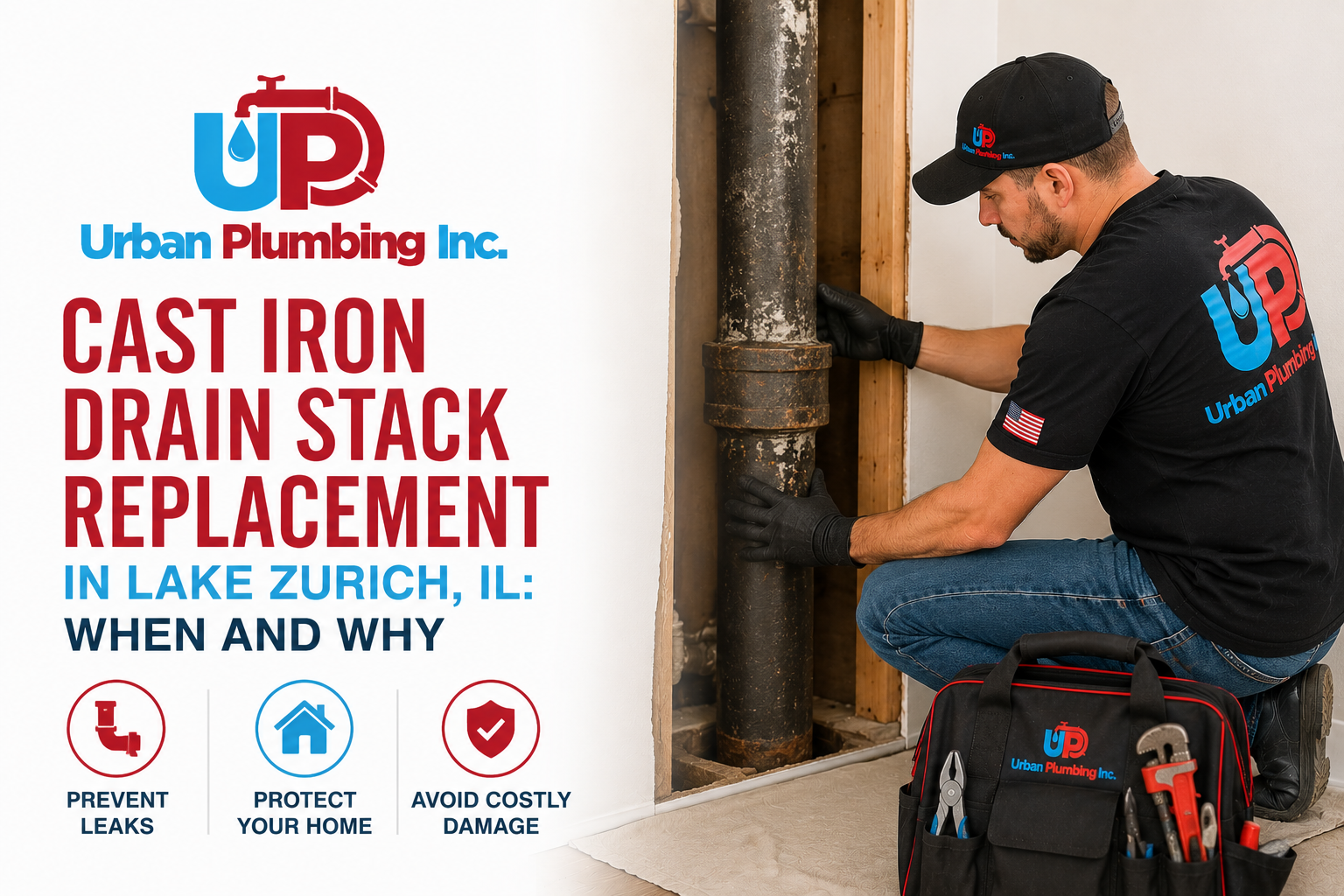
What Is a Cast Iron Drain Stack?
A drain stack is the vertical pipe that runs from the lowest plumbing fixture in your home up through the roof, carrying wastewater down to the sewer lateral and venting sewer gases out above the roofline. From roughly 1900 through the mid-to-late 1970s, residential drain stacks were typically made of cast iron, joined at hub-and-spigot connections sealed with lead and oakum.
Cast iron drain stacks have a service life of 50 to 75 years depending on water chemistry, usage volume, and installation quality. Many Lake Zurich homes built in the 1940s, 1950s, and 1960s are now well past that service expectation, and we’re seeing failures across the entire Northwest Suburbs as that housing reaches end of life.
How Cast Iron Drain Stacks Fail
Failure happens from the inside out. Wastewater flowing through cast iron pipe over decades causes a slow oxidation process that corrodes the interior pipe wall, eventually creating rust scale that flakes off and accumulates at the bottom of horizontal runs. The pipe wall thins progressively until it can no longer hold pressure during flow events, at which point you get one of three failure modes:
Pinhole leaks along horizontal sections, typically in basements or first-floor ceilings, causing slow drips that stain drywall and create persistent musty smells.
Hub joint failure where the lead-and-oakum seal degrades and the joint begins to weep, often causing visible rust stains down the side of the pipe and structural decay around the joint.
Catastrophic collapse where a horizontal section gives way under flow load, dumping wastewater into the wall cavity, ceiling, or basement. This is the failure mode every homeowner wants to avoid.
Warning Signs in Older Lake Zurich Homes
If your Lake Zurich home was built before 1980 and you notice any of these symptoms, schedule a stack inspection:
- Slow drains throughout the house (not just one fixture)
- Sewer gas smells in basements, mechanical rooms, or first-floor closets
- Rust-colored water staining around the base of the stack where it enters the basement
- Visible rust flaking on the exterior of the cast iron stack
- Bubbling or backing up in floor drains during heavy water use
- Damp drywall or paint bubbling along walls where the stack runs vertically
- Recurring small leaks that seem to “resolve themselves” only to return weeks later
Any one of these symptoms warrants a borescope inspection of the stack. Multiple symptoms together strongly suggest the stack is in advanced failure and needs replacement.
The Illinois Department of Public Health plumbing program regulates statewide plumbing standards including drain-waste-vent system requirements, which we follow on every stack replacement.
Why Lake Zurich Homeowners Should Address Failing Stacks Proactively
Stack replacement is significantly cheaper and less disruptive when it’s planned than when it’s an emergency. A scheduled replacement happens during business hours, with proper drywall protection, organized fixture isolation, and finish patching coordinated in advance. A catastrophic stack failure happens at the worst possible time, typically requiring emergency dispatch, immediate water cleanup, mold mitigation in finished spaces, and rushed repairs that don’t allow the same quality of finish patching.
The cost differential between planned and emergency stack replacement can easily run $5,000 to $15,000 or more once water damage and mold remediation enter the equation. The EPA’s mold and moisture guidance explains why fast water response matters and why preventing the leak in the first place is dramatically more cost-effective.
What Cast Iron Stack Replacement Involves
Urban Plumbing’s stack replacement process for Lake Zurich homes generally includes:
- In-home assessment with borescope inspection of accessible sections
- Written estimate covering plumbing scope, drywall cuts, and finish coordination
- Strategic drywall removal along the stack run to expose pipe
- Cap and isolation of all branch fixtures during work
- Removal of failing cast iron sections
- Installation of new PVC or cast iron stack (homeowner preference, both are code-compliant)
- New branch tie-ins for all connected fixtures
- Pressure testing and inspection
- Drywall patch and paint coordination through trusted finish contractors
A typical single-family stack replacement takes 2 to 4 days depending on home size and stack length. We provide a written timeline as part of the estimate.
Cost Range for Lake Zurich Stack Replacement
Full cast iron drain stack replacement in a typical Lake Zurich single-family home runs $4,000 to $9,000, with larger or more complex homes running higher. Cost factors include stack length, number of branch fixtures tying in, accessibility, and finish patching scope.
Free written estimates with no obligation. Call (224) 483-8438.
Why Choose Urban Plumbing for Stack Replacement
We work in the older housing stock across Lake Zurich, Inverness, Arlington Heights, Palatine, and the original Barrington estate corridor regularly, and stack replacements are some of the most common large jobs we handle. We work efficiently, coordinate finish patching, and provide written timelines and pricing up front. Read our customer reviews and our main sewer rodding and inspection guide for related context.
Frequently Asked Questions
Does my Lake Zurich home have cast iron drain stacks? If your home was built before 1980 and the original drain plumbing hasn’t been replaced, almost certainly yes. We can confirm with a quick inspection.
Can a failing stack be repaired instead of replaced? Small isolated leaks at a single joint can sometimes be repaired with a sleeve or spot fix. Widespread corrosion or multiple-point failure almost always requires full stack replacement.
Is cast iron or PVC better for the replacement stack? Both are code-compliant. Cast iron is quieter (an advantage in multi-story homes where the stack runs through bedroom walls) and more durable long-term. PVC is lighter, easier to install, and less expensive. We discuss the tradeoffs during the estimate.
How long does Urban Plumbing’s stack replacement work take? 2 to 4 days for a typical Lake Zurich single-family home. Larger homes or more complex stack configurations may take longer.
To schedule a cast iron drain stack inspection in Lake Zurich, call (224) 483-8438 or contact us online.
Cast iron stack replacement is one of the jobs our repiping service handles most often in older Lake Zurich homes.