
Why Do Pipes Bang When Water Shuts Off?
Pipes often bang when a quick-closing valve stops moving water and creates a pressure wave, a condition commonly called water hammer. The sound can also come from a pipe shifting against framing, unusually high pressure, a worn valve, or more than one condition happening at once.
The timing is the most useful first clue. A sharp bang when a washing machine stops filling, a toilet finishes refilling, or a faucet snaps closed points toward a supply-side pressure or movement problem. A plumber still needs to reproduce the trigger before choosing an arrestor, pressure correction, valve repair, or pipe support.
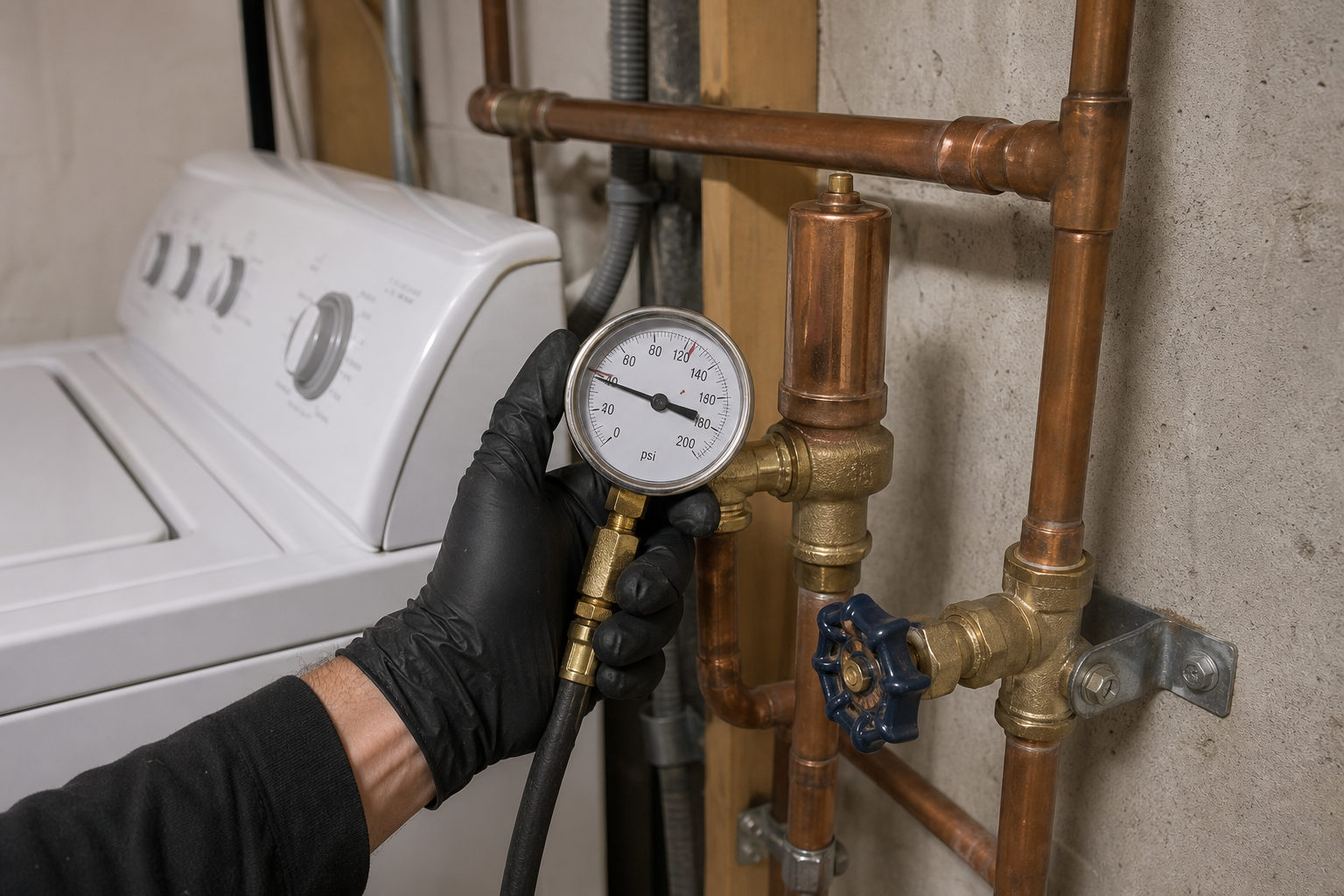
What Water Hammer Actually Means
Water in a supply pipe has mass and velocity. When a valve closes abruptly, that moving water cannot stop everywhere at exactly the same moment. The rapid change sends a pressure wave through the piping. A nearby elbow, valve, branch, or unsupported pipe may move enough to produce the bang you hear.
Water hammer and pipe movement are related but not identical. Hydraulic shock happens inside the water column. Mechanical impact happens when the pipe or a connected part shifts and contacts wood, metal, masonry, or another pipe. The pressure wave may cause that movement, but simply adding an arrestor will not correct a loose pipe striking a joist.
Why Not Every Plumbing Noise Is Water Hammer
A hard thud after a valve closes is different from noise that continues while water is running.
- A rapid rattle during flow may point to a loose washer, valve component, or pipe support.
- Ticking that begins as hot water moves through a line may be thermal expansion against framing or a tight opening.
- Gurgling after a fixture drains usually belongs to the drain and vent system, not the pressurized supply piping.
- A bang near a pump or check valve may involve that equipment rather than a faucet or appliance valve.
- A hiss, whistle, or vibration can indicate restriction or valve behavior that needs a different diagnosis.
The apparent location can be misleading. Sound travels along copper, steel, and framing, so a bang heard over one room may start at an appliance or valve farther away.
Common Conditions Behind a Bang or Shudder
The trigger pattern narrows the possibilities. The same noise can result from how quickly flow stops, how pressure behaves, how the pipe is supported, or how a nearby control component is working.
A fast-closing fixture or appliance valve
A solenoid valve can stop flow much faster than a person closes a traditional handle. If the sound happens only when one washing machine, dishwasher, toilet, or ice maker stops filling, that valve and its branch deserve attention. The valve may be exposing another system condition or may itself be worn.
Pressure that is too high or poorly controlled
Higher pressure can increase the forces involved, but one loud bang does not prove that the building pressure is excessive. Pressure can also change as neighborhood demand, elevation, a pressure-reducing valve, and fixtures affect the system.
A plumber may compare static pressure with working pressure while selected fixtures operate. Readings must be evaluated against the building, current requirements, connected equipment, and manufacturer limits. No single number diagnoses every Lake Zurich home.
Loose or poorly isolated piping
Supply piping needs support, but it also needs appropriate clearance and protection where it passes through framing. A missing clamp, an oversized opening without cushioning, or direct contact between pipe and framing can turn small movement into a loud impact.
Copper, steel, PEX, and mixed-material systems move and transmit sound differently. Supports must match the material and location without crushing the pipe or creating another noise.
An arrestor, air chamber, regulator, or check valve problem
A mechanical water-hammer arrestor uses a sealed cushion to absorb part of the pressure surge. Older systems may have simple vertical air chambers that lose effectiveness over time. A failed arrestor, a pressure-reducing valve that no longer controls consistently, or a check valve that closes forcefully can change the noise pattern.
Replacing one visible part without diagnosis may leave the actual trigger untouched.
Safe Observations to Make Before the Appointment
You can collect useful information without opening a wall, adjusting a regulator, or disconnecting an appliance. Note what causes the sound and whether it happens every time.
Record:
- Which faucet, toilet, appliance, or valve was operating.
- Whether the sound occurs when flow starts, while it runs, or when it stops.
- Whether you hear one bang, several knocks, a rattle, or a longer vibration.
- Which room or wall sounds loudest.
- Whether the problem began after plumbing or appliance work.
- Whether more than one fixture can trigger it.
- Any visible pipe movement, moisture, corrosion, or leaking connection in an accessible area.
A short recording can help, but do not repeatedly slam a valve to make the noise louder. Do not remove wall finishes, alter pressure controls, disconnect supply hoses, or tighten concealed piping as a test.
If the bang is accompanied by a visible leak, shut off the affected fixture or the home’s water only if the valve is safely accessible. Stay clear of water near electrical panels, receptacles, wiring, or appliances. A noise by itself may not be an emergency, but active leakage or water near electricity needs prompt attention.
How a Plumber Diagnoses the Cause
A targeted diagnosis begins by confirming the trigger. The plumber may operate fixtures separately and listen at accessible branches to distinguish a whole-system condition from one valve or pipe run.
Pressure testing provides another piece of evidence. Static and working readings can show whether pressure is stable, drops unusually during demand, or changes when a regulator or valve operates. A single reading taken at one moment cannot show the complete pattern.
The plumber may then inspect accessible pipe supports, framing penetrations, shutoff and fill valves, appliance connections, check valves, and any existing arrestors. If a sound appears to start inside a finished wall, listening tools and trigger testing can narrow the likely area before an opening is considered.
Homeowners looking for plumbing services in Lake Zurich should expect the proposed repair to connect directly to the observed trigger. Ask what was reproduced, what was measured, and why the recommended component or access point addresses that evidence.
When a Water-Hammer Arrestor Can Help
An arrestor can be effective when a fast-closing valve is creating a pressure surge and the device is correctly selected and installed near that source. Size, location, orientation, pipe arrangement, and manufacturer requirements all matter. An arrestor installed far from the trigger or chosen without considering the branch may not control the surge as intended.
It is not a universal cure. An arrestor will not secure a pipe that is striking framing, repair a failing valve, or correct pressure that is outside the proper operating conditions. More than one correction may be appropriate when hydraulic shock and loose piping occur together.
Avoid improvised capped pipes or one-size-fits-all devices. A plumber should identify the closing valve, evaluate the branch, and choose an approved component for that application.
Pipe Securing and the Access Tradeoff
When physical movement is the problem, repair may involve compatible clamps, cushioned contact points, or corrected clearance. Exposed utility piping is easier to support than piping concealed behind tile, cabinets, drywall, or a finished ceiling.
Opening a finished surface should follow evidence. The loudest spot is not always the impact point. A plumber can isolate the trigger and use listening or movement clues to choose the smallest practical access area.
Support work also requires restraint. Too little support allows impact, while an unsuitable or overly tight clamp can damage the pipe or interfere with normal expansion. The goal is controlled support with appropriate materials, spacing, and clearance for the actual piping system.
Some smaller valve and support issues may fall within minor plumbing repair, but the scope should be based on the diagnosis rather than the volume of the noise.
Schedule a Pipe-Noise Diagnosis in Lake Zurich
A new or forceful bang deserves attention before repeated movement strains a connection or an existing leak grows. Urban Plumbing can identify the trigger, measure pressure behavior, inspect accessible valves and supports, and explain whether the evidence supports an arrestor, valve repair, pressure-control work, or targeted pipe securing.
Contact Urban Plumbing to schedule an evaluation and get a repair recommendation tied to the exact noise in your Lake Zurich home.
Banging pipes that turn into leaks are a job for water leak detection, and aging lines that keep failing are a case for repiping.